Before we tell you what to change, we’ll show you what we found.
A short, human-researched look at your plumbing company—what’s working, what caught our attention, what we’d protect and where we’d investigate first. Not an automated SEO score. Not a scare-tactic audit.
We don’t ask you to trust that our strategy will be personal. We do the research first and show you.

The Field Report isn’t a lead magnet attached to the website. It’s the first deliverable of the method—the same research we use to decide whether a company is worth approaching in the first place.
An informed first look—not a fake final diagnosis.
The normal agency funnel is: enter your email → automated crawler → scary score → sales call → giant proposal. That doesn’t fit how we work. A Field Report answers a more useful question: what do we know about this specific plumbing company before we’ve asked you to buy anything?
Tool-generated. Generic. Surface-level.
- A score
- A list of errors
- A generic checklist
- An immediate pitch
Human-researched. Specific. Honest about its limits.
- Your business strengths, first
- Evidence, not just conclusions
- Three observations that matter
- The biggest opportunity
- What we’d protect
- The questions still unanswered
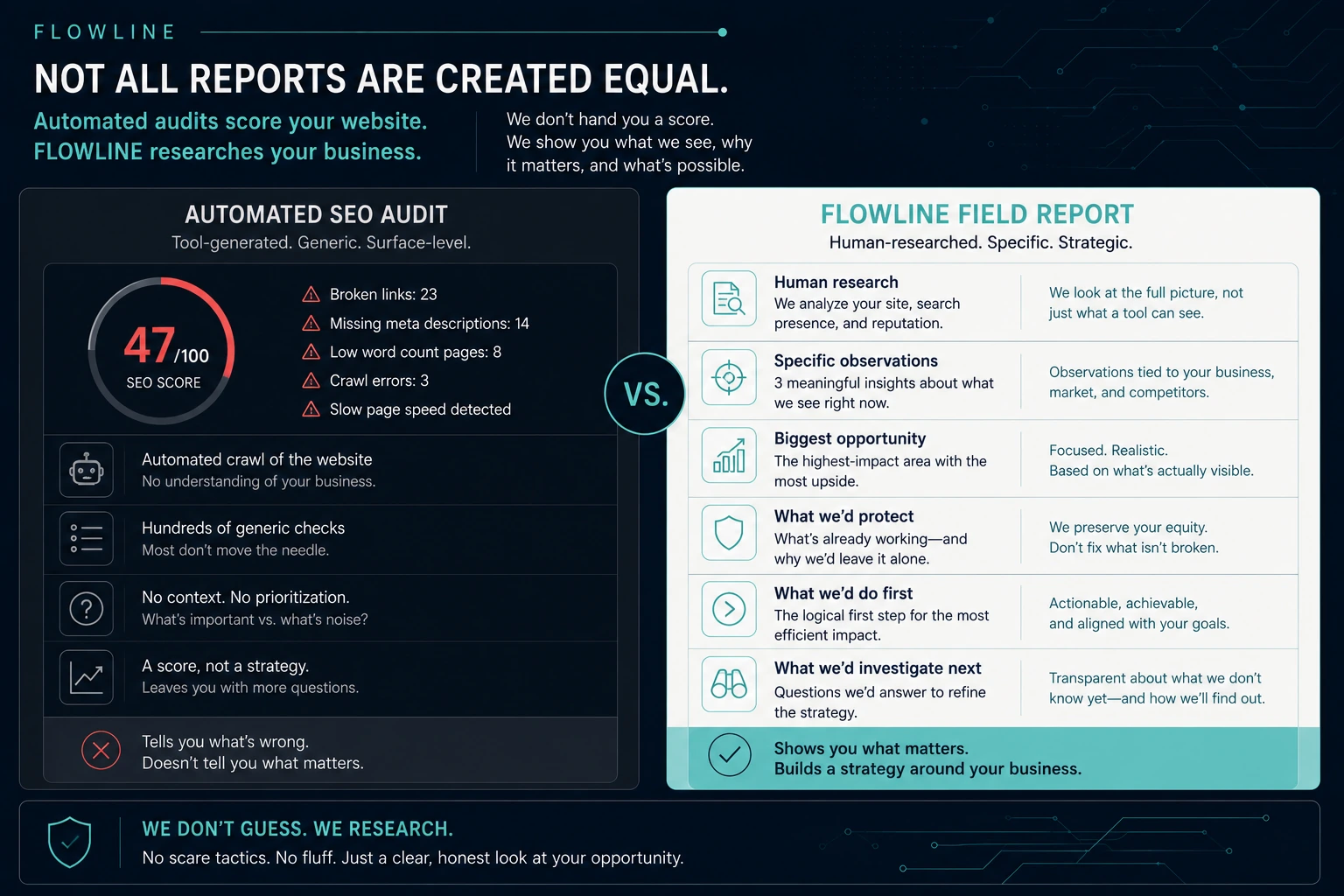
Automated audits score your website. We research your business.
Anyone can write “custom strategies” or “personalized SEO.” We prove personalization by doing company-specific research before the proposal exists.
What we can see. What we need from you.
A significant amount can be researched from public evidence before we ever speak. Some questions can’t—and we don’t pretend public research can answer them.
What we research before we talk.
What only you can tell us.
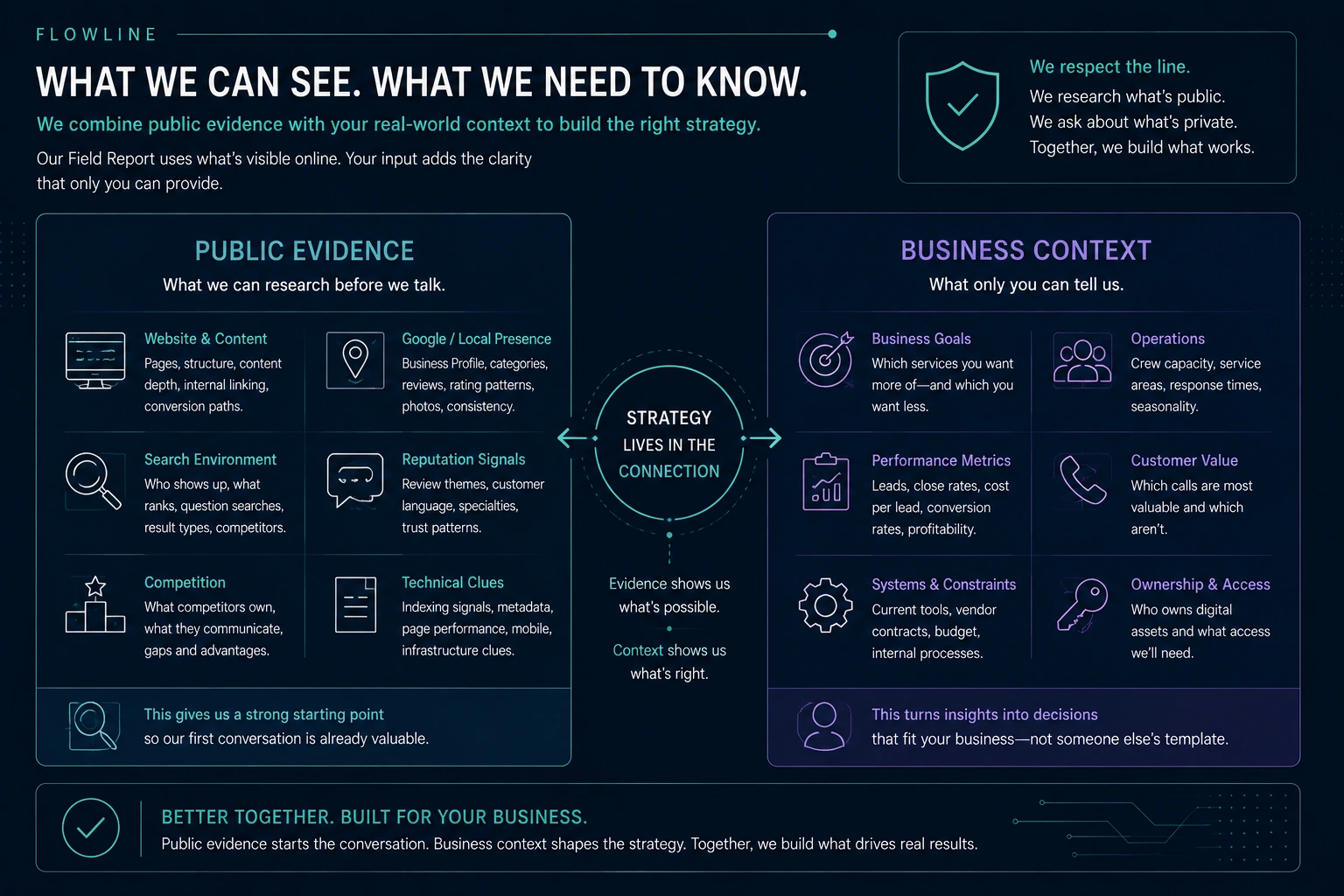
Strategy lives in the connection. Evidence shows what’s possible; context shows what’s right.
The report starts with the left side. Good strategy requires both.
Six sections. One purpose: clarity before any proposal exists.
What’s already working
Reputation, reviews, specialties, useful pages, rankings, domain equity, team expertise, location relevance. This goes first deliberately—not as flattery, as evidence. We looked at the company, not just the mistakes.
Three observations
The three things that tell the most important story about this business. An observation isn’t automatically a problem—it can be positive. This is not a 72-point technical dump.
The biggest opportunity
If we could move one meaningful part of this system first, where would it create the most leverage? Different for every company: architecture, a specialty, Maps and reputation, location visibility…
What we’d protect
Existing equity, named explicitly: this URL, this ranking, these reviews, this booking system, this brand language. We would not disturb it without evidence that the replacement creates more value than the risk.
What we’d do first
Not the whole proposal. The specific first move—useful even if you never hire us. That’s deliberate.
What we’d investigate next
Where our evidence stops. What we’d need from you before recommending action—Search Console access, profitability, territory, vendor agreements.
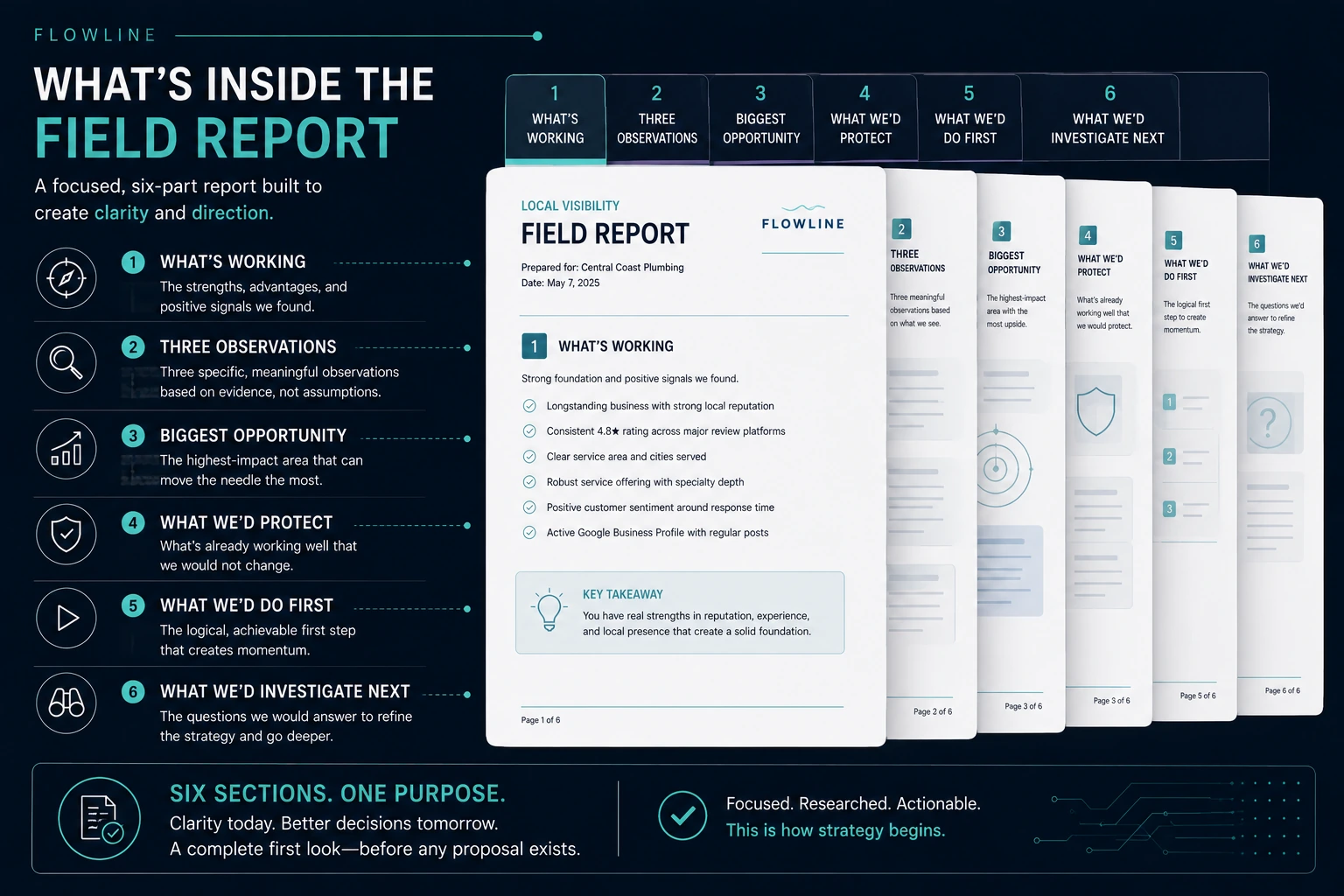
The six-part report, page by page.
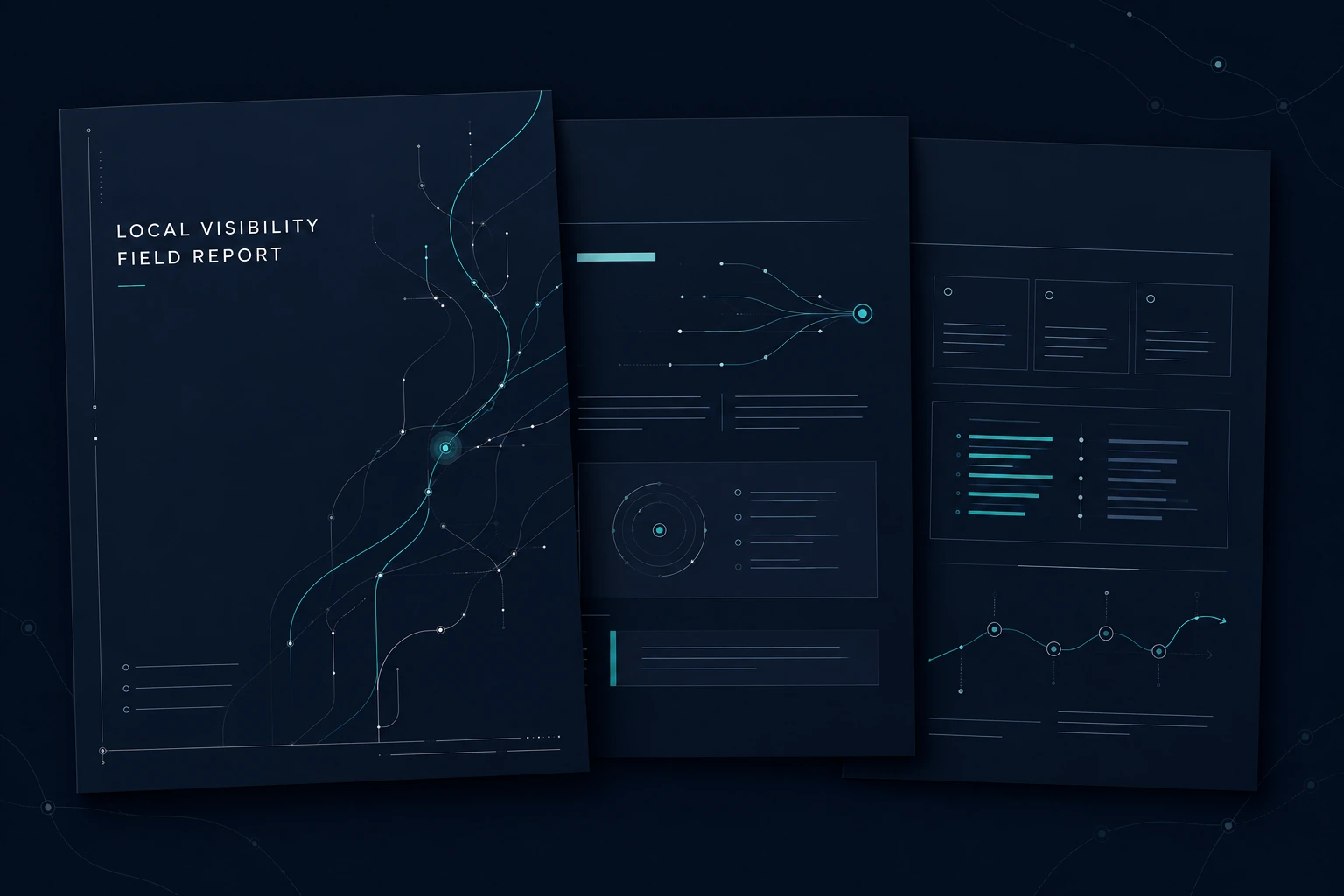
Report spreads: evidence, observations and the pathways between them.
Evidence, not just conclusions.
Every finding follows the same chain—Observation → Evidence → Opportunity → Protect → First Move → Investigate Next. That’s the unit of thought we sell. It is much more useful than “missing H2 tag.”
Customers frequently mention hydro jetting and sewer-camera diagnosis—but that expertise is barely represented on the website.
Review excerpts naming the service · visible service references · three competitors with dedicated pages for the same search journey.
Make a proven specialty easier to discover, instead of leaving it buried under a generic “Drain Services” page.
Existing review equity and the primary drain-service URL that already ranks.
Clarify service ownership and strengthen the current page before creating anything new.
Search Console demand for the specialty · whether those jobs are profitable · whether the crew wants more of them.
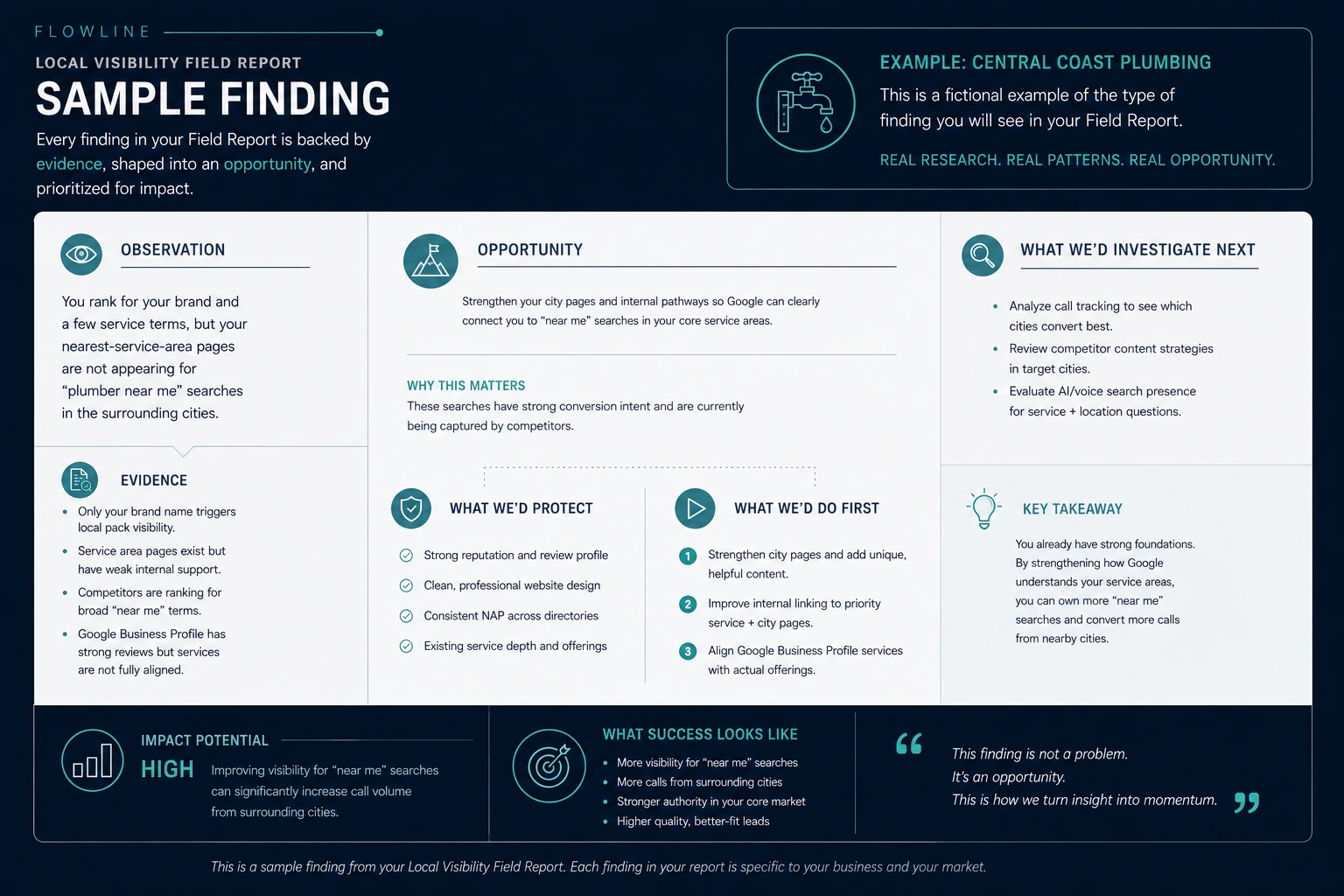
A sample finding from a fictional Central Coast plumbing company: observation, evidence, opportunity, protection, first move, what we’d investigate next.
Three levels of confidence, stated plainly
We can directly verify it.
“The company lists 14 services but has only four dedicated service pages.”
Several pieces of evidence point the same way.
“Reviews repeatedly mention tankless water heaters, but that expertise is barely represented on the website.”
Could be an opportunity—we need your side first.
“Oxnard looks like a viable expansion market, but we don’t know whether that drive radius or job mix is desirable.”
This is what keeps the report from overselling certainty.
Business quality and digital representation are not the same thing.
A strong plumbing company can have a weak website. A strong website can also hide the company’s most valuable capability. The digital gap is not evidence that the business itself is weak—and owners are tired of hearing that everything the last person did was wrong.
A report might show that three competitors appearing consistently for a service have dedicated pages with strong local proof. It will not conclude “copy those pages.” Their visibility tells us the search journey matters in the market—then we determine what your company can legitimately say about it.
We’re not complimenting everybody because we want the sale. We’re separating what the business has built from how well the internet currently shows it.
Receiving a Field Report doesn’t mean we’ve already decided what you should buy.
The sequence is research → report → conversation → context → recommendation → proposal. Not sales call → package → contract → maybe research later.
RESEARCH
We gather public evidence: website, Business Profile, search landscape, reviews, competitors.
FIELD REPORT
We show you what we see—strengths, three observations, opportunity, protection, first move.
CONVERSATION
We align on your goals: which services, which cities, which jobs you actually want.
BUSINESS CONTEXT
Profitability, capacity, lead sources, vendor agreements—what only you can tell us.
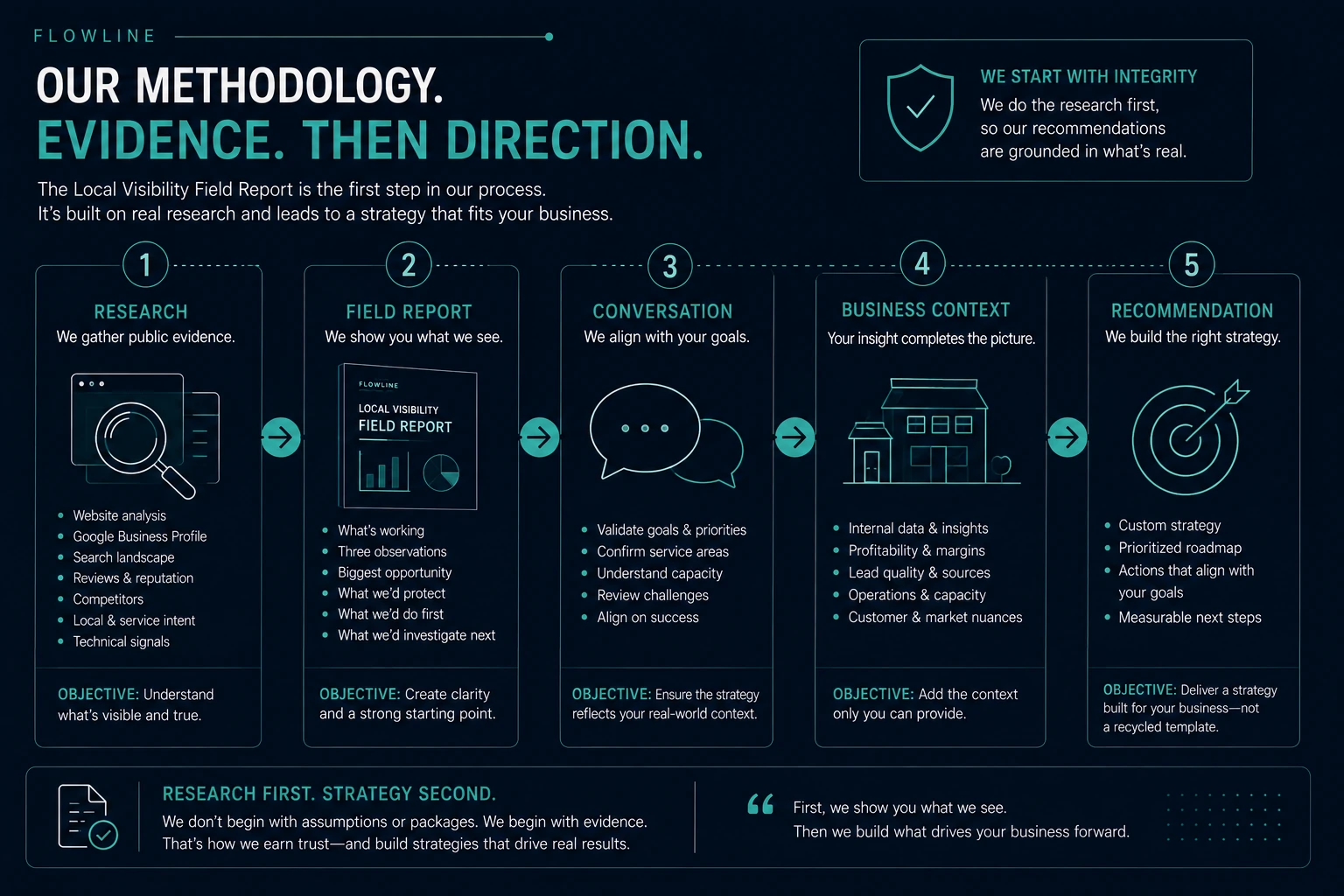
Research first. Strategy second. That’s how we earn trust—and build strategies that fit the business.
You don’t need to know what you need.
Tell us who you are and where to look. No package selection, no budget question, no 25-field intake form. We do the research; you get the report—useful whether or not we ever work together.
- A guaranteed ranking forecast
- A complete technical audit
- A complete Search Console analysis
- A business valuation
- A competitor takedown
- A canned AI report
- An automatic proposal
- Permission to change anything on your site
Our workflow requires a current benchmark and an ownership/vendor check before any final proposal—and we never make public changes to a site without authorization.
Local Visibility Field Report
A short form. We’ll take it from there.
We read. We look. We click. We call. So you don’t have to.