
Water Fixers was not a clean-sheet project. It was a live Central Coast plumbing and water-treatment company with years of history, existing rankings, complicated services, a messy page architecture and customers calling every day. It could not simply be torn down and started over.
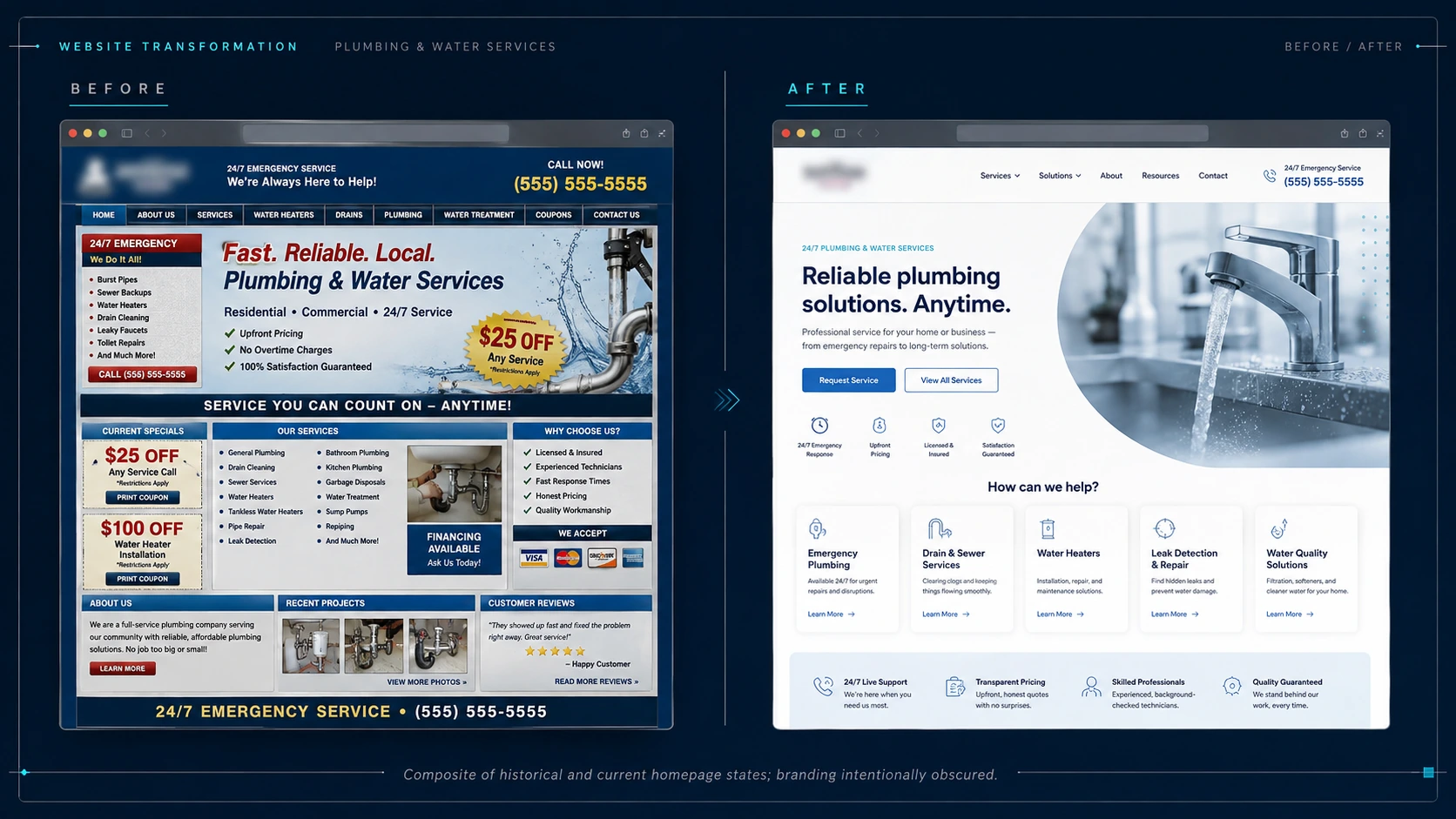
In October 2025, Water Fixers had a website. Today it has a connected search architecture.
Composite of real historical and current homepage captures; branding intentionally obscured. Nothing was reconstructed.
Water Fixers isn’t a one-service plumbing company. Traditional “make me an SEO website” thinking doesn’t handle a service mix like this particularly well.
Broad pages were expected to answer many different needs, so they competed with each other for the same search intent.
City and service templates could easily become repetitive if scaled without meaningful differentiation.
Decades of field knowledge lived inside the company instead of becoming searchable, customer-facing information.
A rebuild could erase useful URLs, links, rankings and customer familiarity if existing equity was ignored.
A working business cannot tolerate reckless production changes. Backups, local development and approval gates were part of the job.
If a few broad pages try to rank for everything, intent gets muddy. If we clone hundreds of city variants, content gets repetitive. If we rebuild from scratch, we destroy equity. Every easy answer was the wrong answer.
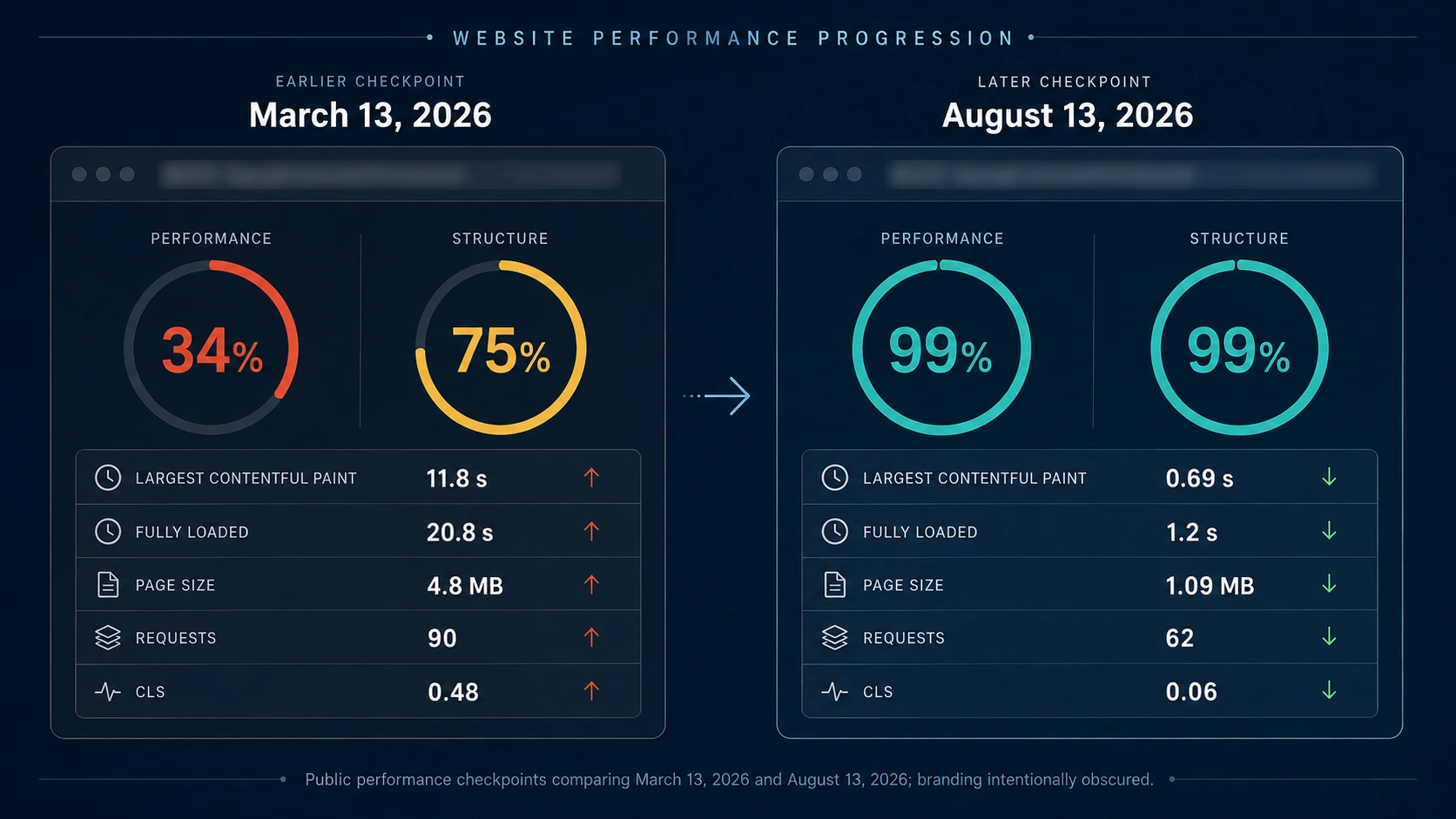
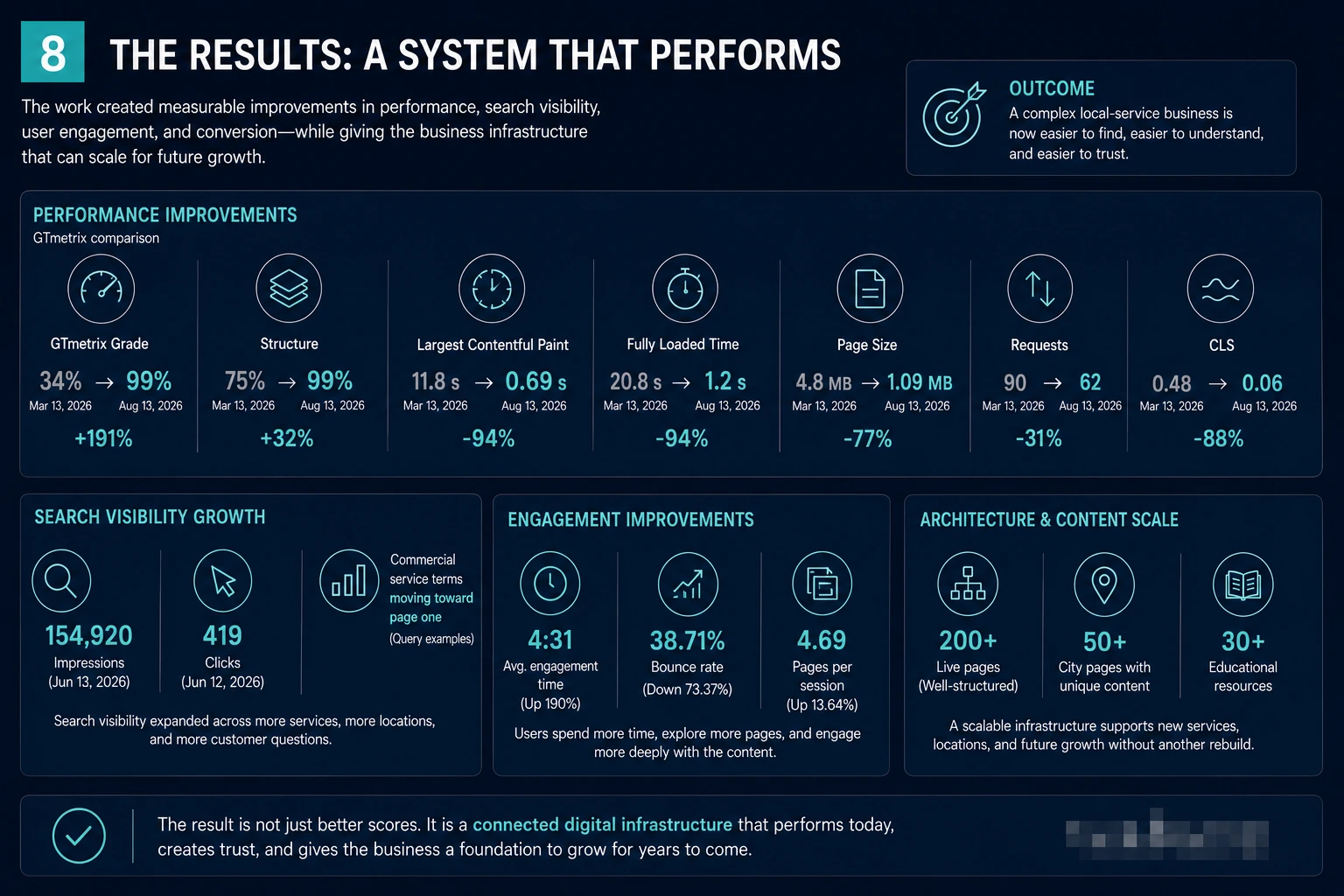
Performance is measurable, date-stamped and doesn’t depend on claiming that SEO caused revenue. These are two preserved GTmetrix checkpoints on the same live homepage, five months apart.
GTmetrix performance
Structure
Largest Contentful Paint
Fully loaded
Page size
Requests
Cumulative Layout Shift
Public performance checkpoints, March 13 vs. August 13, 2026 — built from the preserved GTmetrix reports.
A July 5 checkpoint recorded 100% performance and a 721 ms fully-loaded time. We publish March 13 → August 13 instead because it is a stable, dated pair—not the single best test we could find.
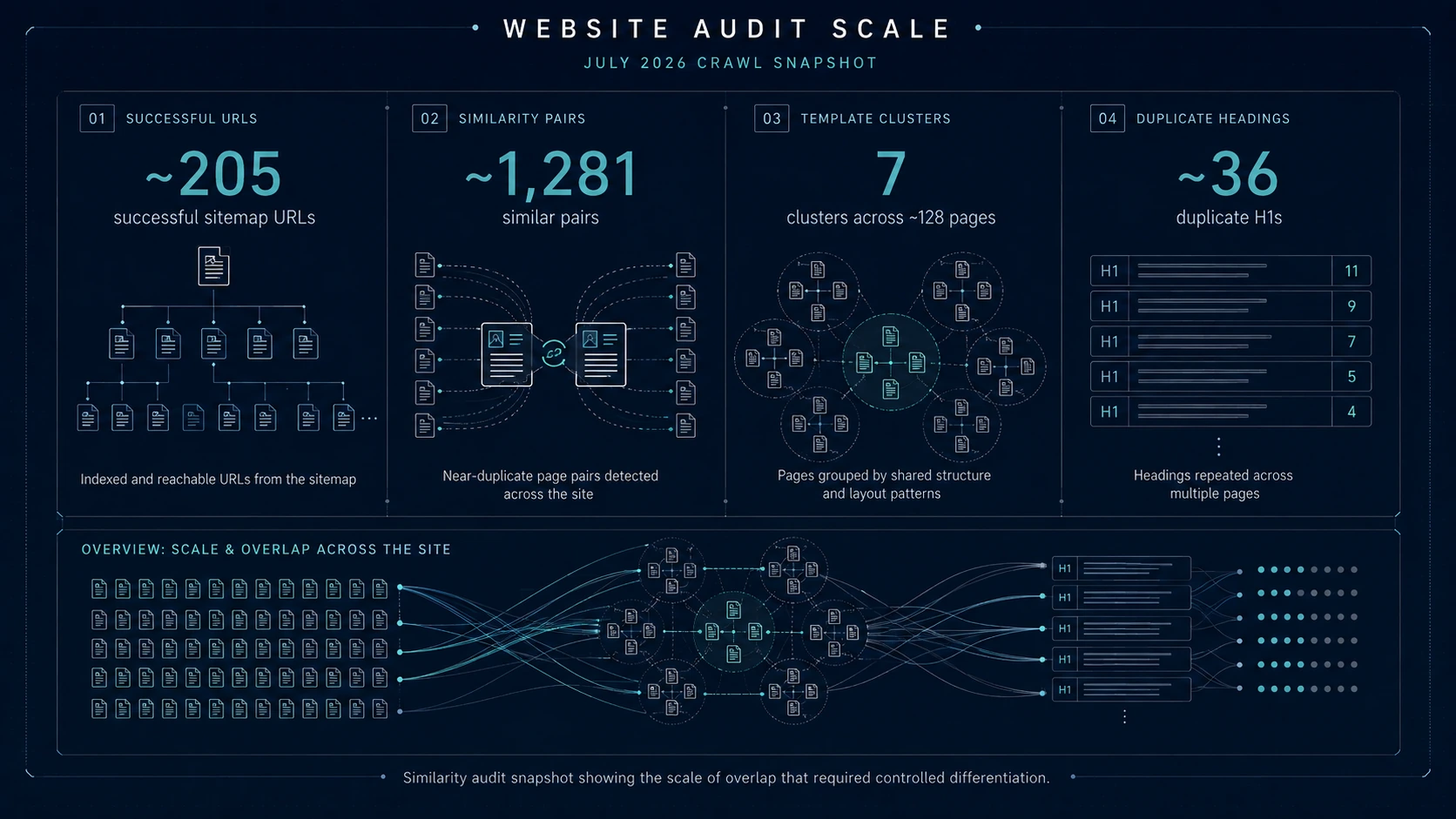
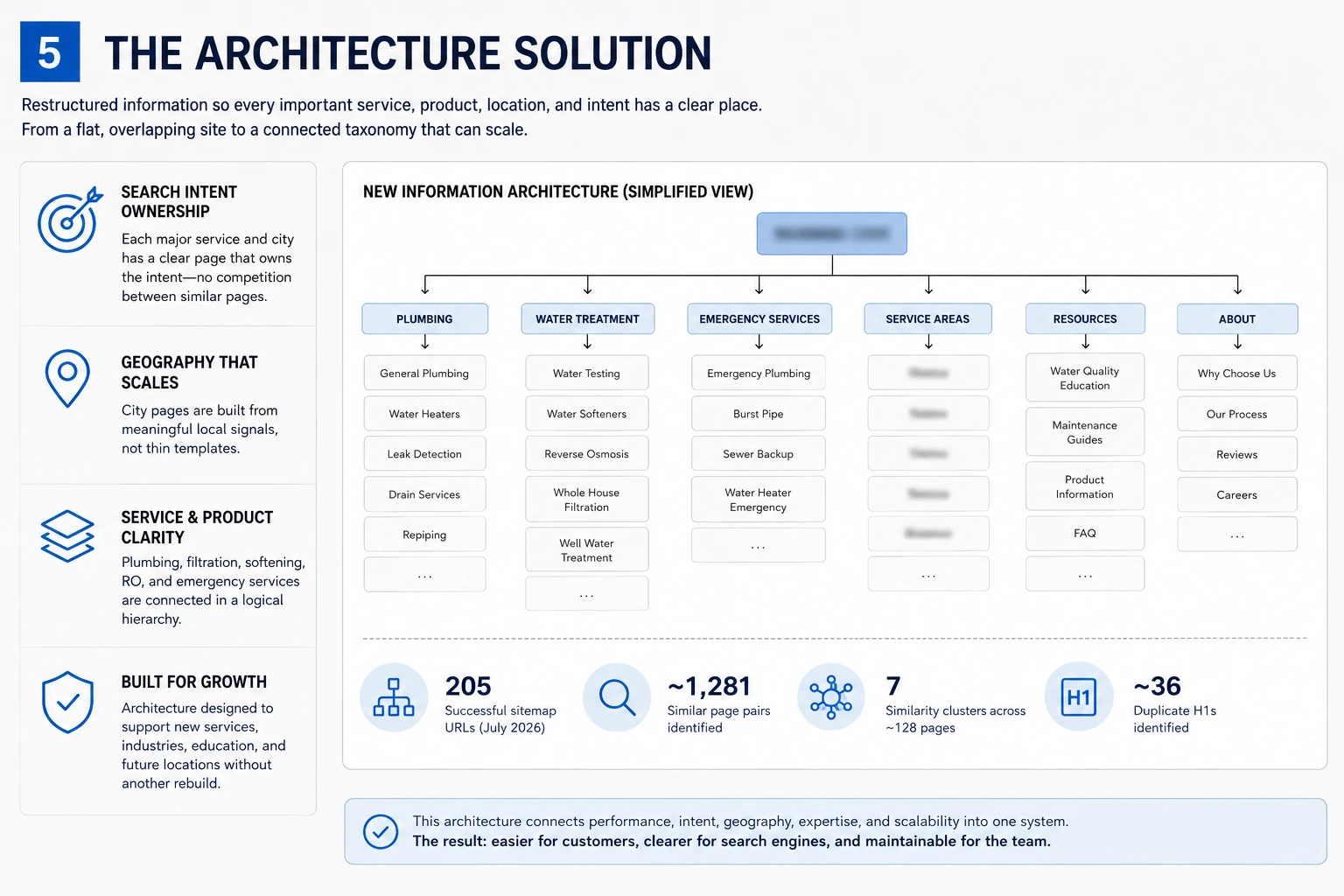
A July 2026 similarity crawl put real scale behind the problem. Its conclusion was explicitly not to mass-publish lightly edited city/service variants, but to differentiate pages and clarify what each one is for.
sitemap URLs responding successfully
similar page pairs detected
template clusters spanning roughly 128 pages
duplicate H1 headings
More isn’t automatically better. Google already saw Water Fixers as relevant to a large number of commercially useful searches—the site just wasn’t giving each intent a strong enough individual destination.
July 2026 similarity-crawl snapshot: the scale of overlap that required controlled differentiation.
Diagnostic findings: performance, structure and the July page audit, read together as one problem.
That research insight is what turned the work toward architecture instead of endlessly rewriting the homepage. Exact client search-analytics figures remain private unless Water Fixers approves publishing them.
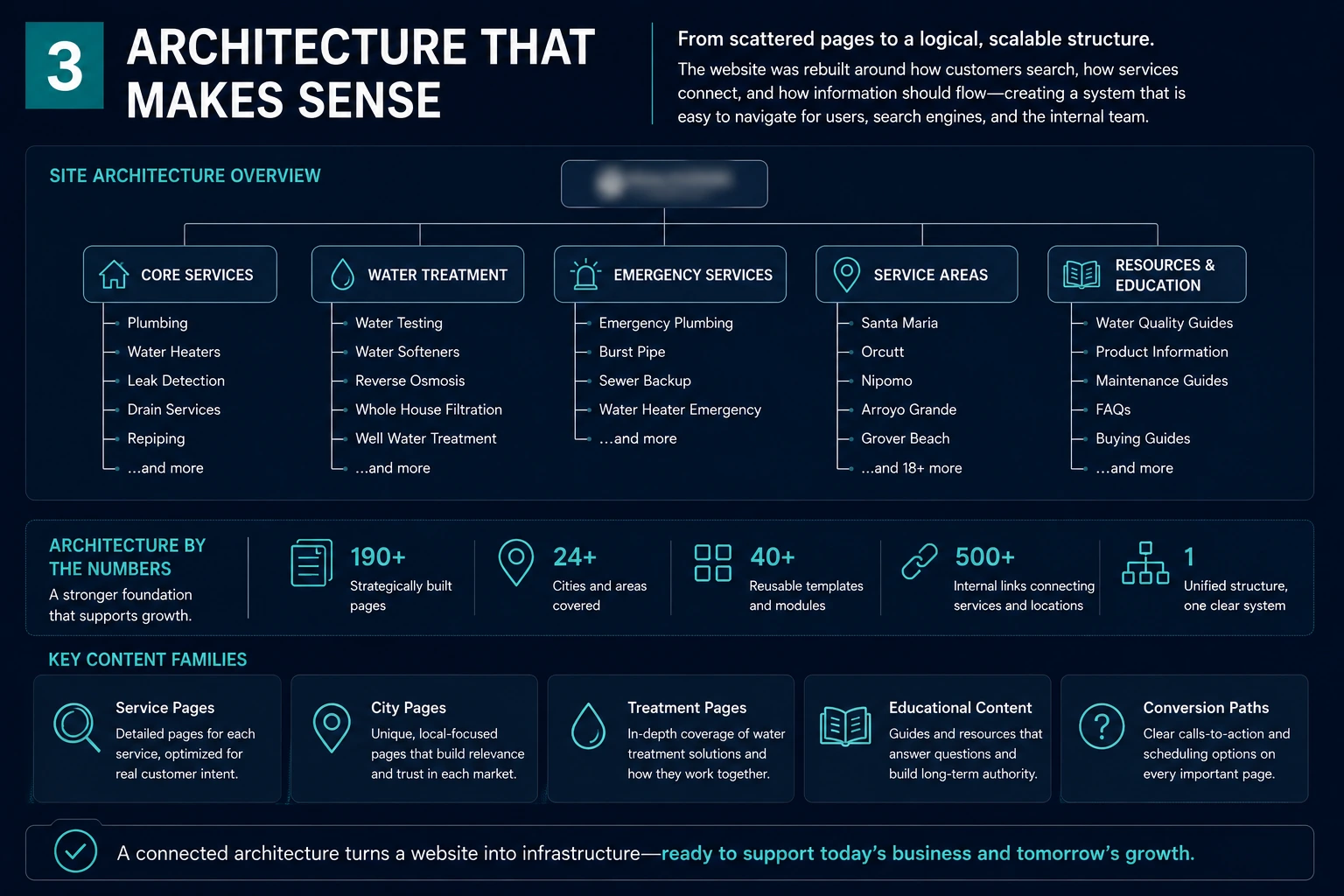
The new site is organized around the ways people actually search—service → product → problem → location—with parent–child relationships and deliberate internal pathways instead of pages that merely exist next to each other.
Broad pages expected to answer many needs
Parent service hubs + specialist pages with clear search ownership
City names and variants risked repetition
Six regional hubs → city / service pathways tied to real service areas
Related concepts blurred together
Testing → filtration / softening / RO / well-water pathways with distinct treatment jobs
One overloaded concept
Systems, comparison, service, maintenance, filters, membranes, sanitizing, local pages
Products and service not systematized
Lineup + comparison + install + repair + maintenance + hard-water education + testing + local
Sales pages carried every piece of knowledge
Codes, permits, licensing, water quality, contaminants, guides, FAQs, comparisons
Secondary, underdeveloped
Plumbing, filtration, softeners, RO, testing, industrial / process water, property management
Page-by-page edits on a live site
Reusable components, backups, local development, approval gates, affected-set QA
The architecture solution: each service, product, location and intent given a clear home in one connected taxonomy.
Site architecture overview: core services, water treatment, emergency, service areas and resources as one system.
That transformation is much more interesting than “we redesigned some pages.”
Local intent became a structure: six regional service-area hubs, each connecting to its cities and to the services that make sense there. No thin city clones—every local page has a job.
Region → city → service. Each level points to a real page on the live site; the homepage routes visitors by problem and treatment need rather than by a service directory.
Rather than “Water Softeners” being a single catch-all page, the softener expertise the company already had was made understandable as a system: products, service, maintenance, education, testing and local intent all connected.
Not “we made more softener pages.” We made the company’s softener expertise understandable as a system.
The live softener hub presents five distinct systems, directs customers between new / replacement, repair and maintenance, connects testing and filtration, and explains that softening and filtration solve different treatment jobs.
Seven listed systems across the CPS, SPS, EPS and UPS families—but the point isn’t the product count. Different customer tasks get different destinations, and every destination reinforces the main subject.
The RO hub now separates “I’m choosing a system” from “I already own one and need help,” then connects each path to its own pages. Topical depth without turning the site into disconnected clutter.
The Water Quality hub tells customers to begin with symptoms and testing rather than guessing which equipment to buy, then routes into distinct conditions.
Contaminant and condition guides give each water problem its own evidence-based explanation and an appropriate treatment path.
Codes, permits, contractor licensing, comparisons, guides and FAQs became supporting resources that reinforce the service pages instead of crowding them.
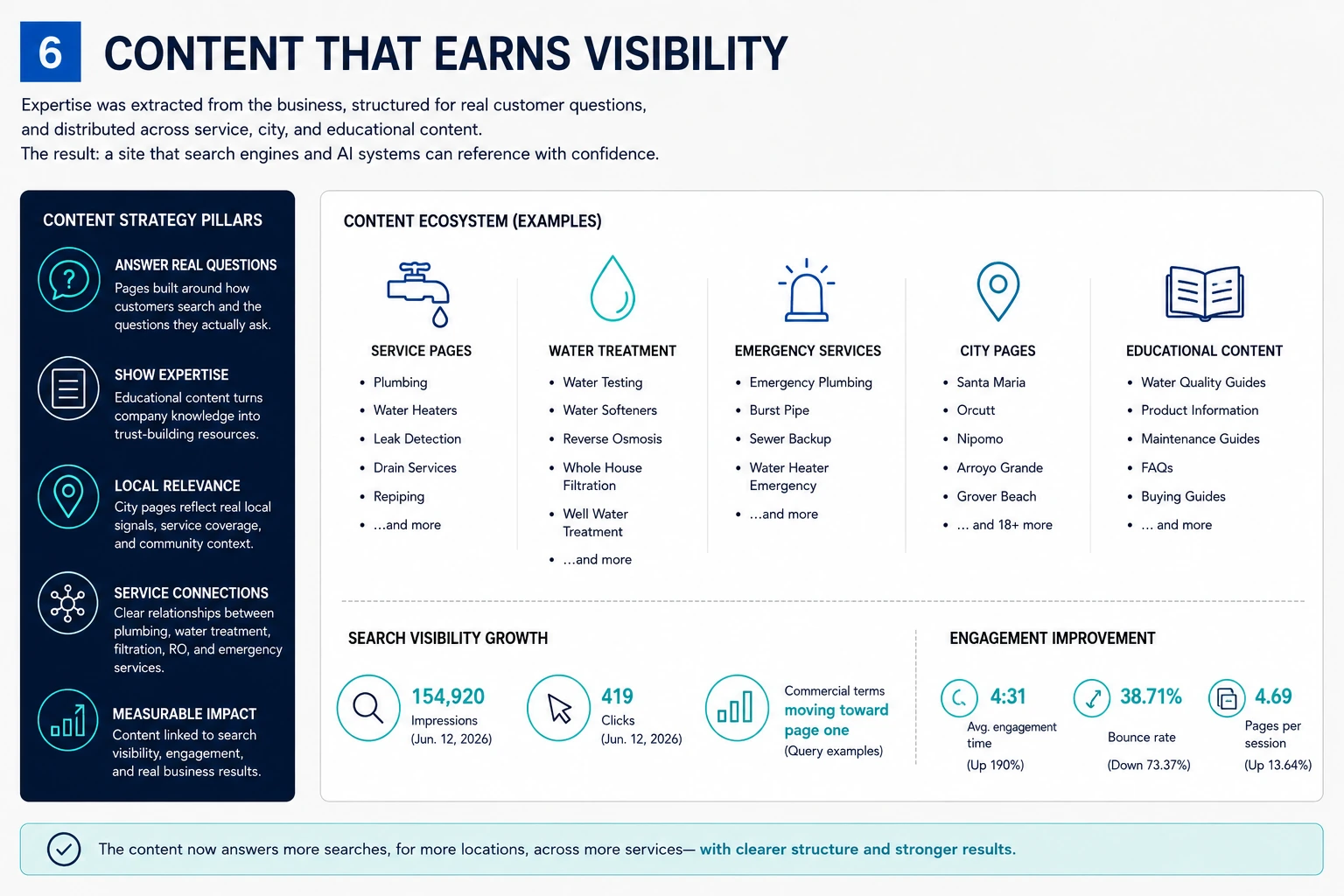
Content that earns visibility: expertise extracted from the business and structured across service, city and educational content.
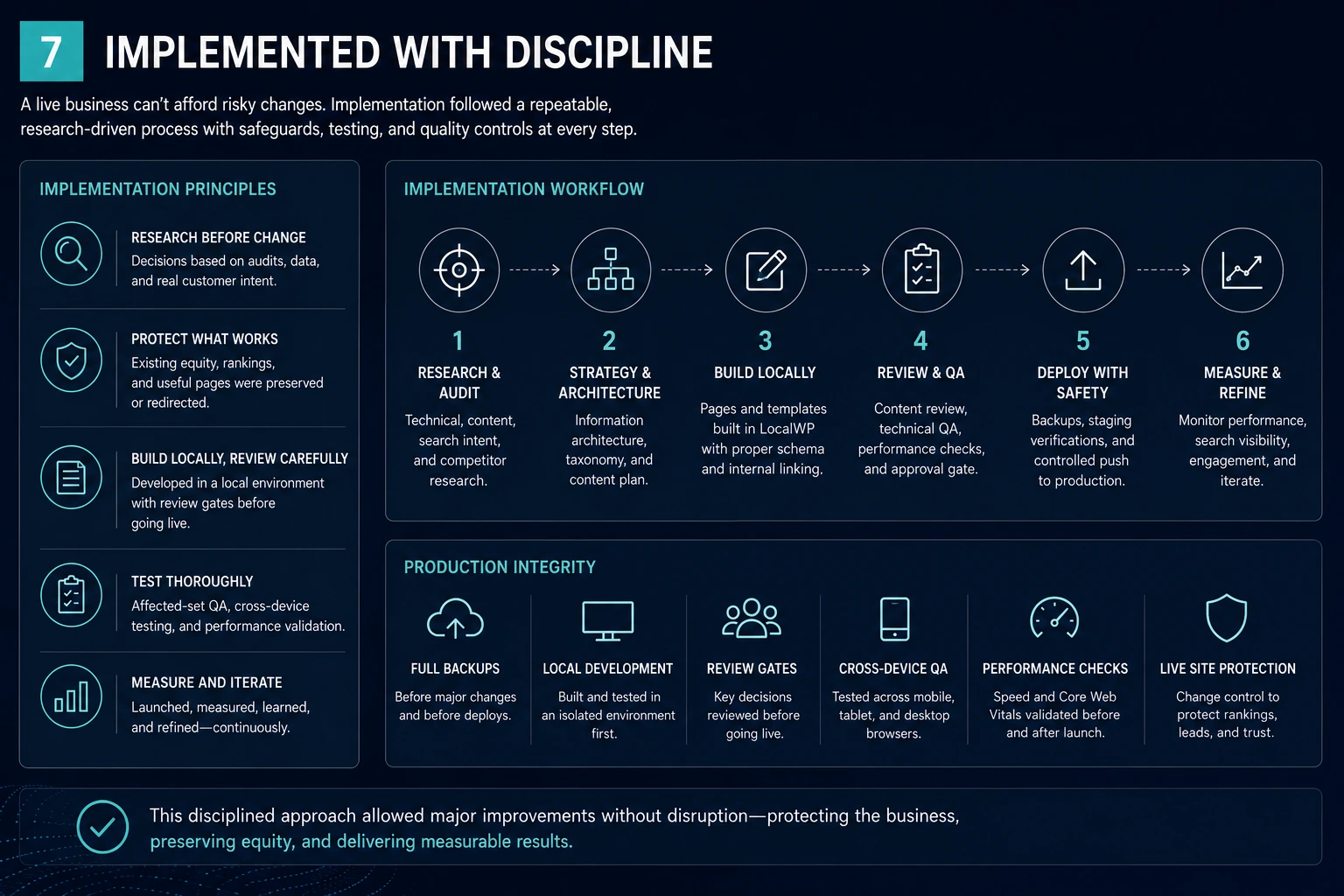
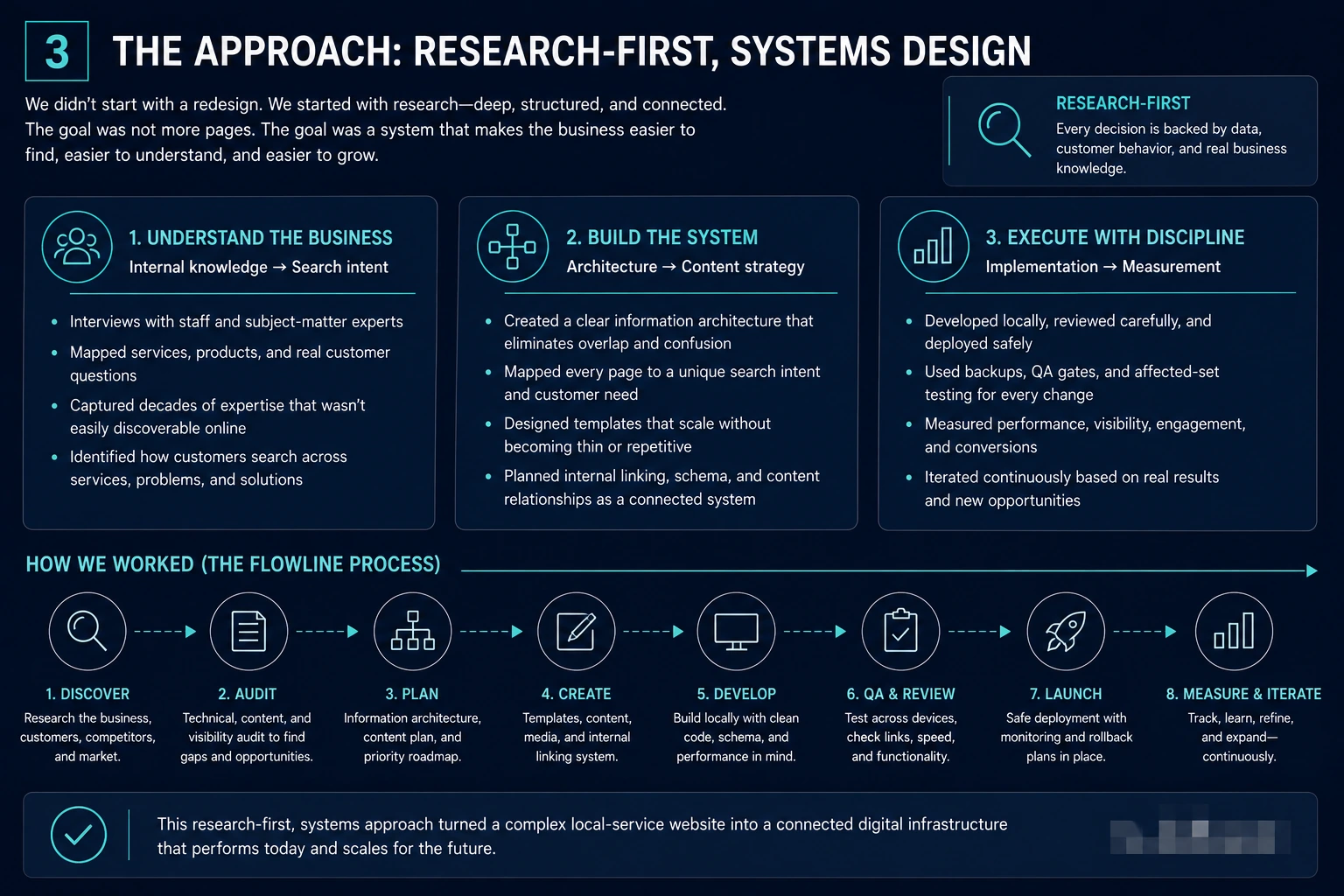
A lot of SEO consultants can hand somebody a 50-page audit. The work here ran research → diagnosis → architecture → implementation → verification as one workflow, on a live business.
Crawl, similarity analysis, search footprint, performance baseline, source preservation.
Architecture and page ownership decided before anything is built.
Reusable native Elementor components, local development first, backups before every production change.
Affected-set QA: responsive layouts, links, forms, metadata, images and every repeated template.
Review gates, then release—with search settings and redirects checked, not assumed.
Implemented with discipline: backups, local development, review gates, cross-device QA and live-site protection.
The research-first, systems-design approach and the eight-step working process behind it.
We verify the affected system—every page a change touches—before it counts as done.
It’s a system that lets an established plumbing company deliberately pursue a service, a customer problem, a city or a new market—and build visibility around real business evidence.
The results: a system that performs — measured improvements in performance, visibility and engagement, plus the architecture that can now be extended.
Scale for context, not as a result: 200+ pages, 100+ local service pages, six regional hubs and twenty city guides were implemented. Credibility matters more than a dramatic claim.
Our Local Visibility Field Report is a short, human-researched look at your company before we recommend a project. Not an automated score. Not a scare-tactic audit.