Most companies don’t have a content problem. They have a capture problem.
The material is already there — the jobs, the diagnoses, the questions customers ask, the work the team is proud of. It just never gets written down.
We help specialized businesses turn what they already do into something publishable, on a rhythm they can actually sustain.
What this service is, and what it isn’t.
Social media is the part of marketing most often sold on promises nobody can keep. So here is the boundary before anything else.
We don’t promise audience numbers, and we don’t buy them.
A set number of posts a week is a schedule, not a strategy.
Reposted stock tips about your trade help nobody and sound like everyone.
Social borrows attention. The website is the thing you own.
Capturing what you already know and shaping it into something worth publishing.
Keeping the presence current and accurate, at a pace the business can sustain.
From the work, not from a calendar.
The best material a specialized business has is the work itself: the job that turned out to be something else entirely, the failure mode you see every spring, the question you answer on the phone twice a day.
None of that needs inventing. It needs noticing, and then a route from the van or the site to somewhere it can be published.
The hard part is getting it out of people’s heads.
Technicians and crews are not going to write blog posts, and asking them to is how these programmes quietly die. What works is a low-friction way to capture the raw material — a photo, a two-line note, a voice message after a job — and somebody else doing the shaping.
We set up that route, and we do the shaping.

The same insight, shaped for where it lands.
One genuinely useful observation can become a short post, a longer explanation, a photo caption and a section on a service page. That is not repetition — the same idea belongs differently in each place.
What we don’t do is push identical text to every channel and call it a presence.
These are not two separate efforts.
Social content is rented attention on somebody else’s platform. The website is the asset you own, and the one search systems read. The sensible arrangement is that the two feed each other: what proves useful in a post is often what deserves a proper page, and a strong page gives social something real to point at.
Which is why this sits alongside the rest of the work rather than beside it.
Sustainable beats ambitious.
Capture what happened. Shape the few things worth publishing. Publish them. Look at what actually connected with people. Adjust. Repeat.
A pace the business can hold for a year beats an intense month followed by silence — and silence is what most social programmes actually produce.
What ongoing content can look like.
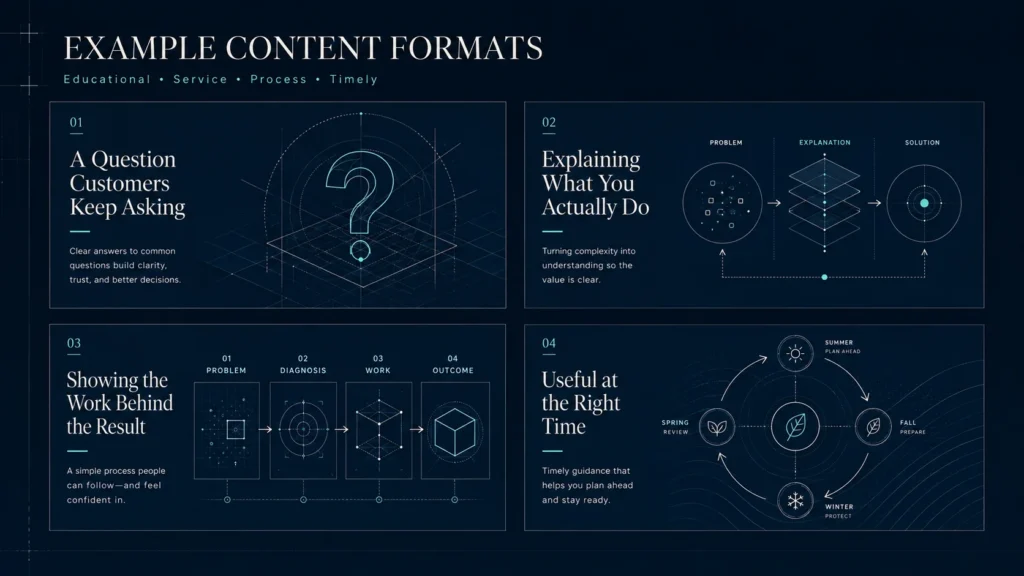
Four formats we can build from things your business already does: the questions customers keep asking, a plain explanation of what you actually do, the process behind a result, and guidance that matters at a particular time of year.
Illustrative content formats.
Honestly, and without pretending it’s a science.
Some things are measurable: what got published, what people engaged with, what drove somebody to the website. Some things aren’t: whether a customer already trusted you before they called because they had been reading your posts for a year.
We report the first honestly, and we don’t take credit for the second.
We investigate before recommending changes.
We identify what should stay intact before rebuilding.
Recommendations are grounded in actual website and technical work.
Performance, accessibility and search health matter alongside design.
The people researching the business shape the recommendation.
We publish the thinking behind the work.
Tell us what you already know that nobody has written down.
That’s usually where this starts — not with a content calendar, but with the work your team does that never makes it past the job site.
Typical investment
Ongoing
Scope varies with content frequency, planning, writing, graphics and how much ongoing support the business needs.